



Organizations facing limited budgets are increasingly turning to uniform pay increases—here’s why the “peanut butter approach” may be undermining effective talent strategy.
By Ruth Thomas
Organizations are facing a paradox in 2026: how to balance fairness with performance when it comes to compensation in an era of constrained budgets. More organizations than expected are turning to a decades-old solution — “peanut butter” pay increases — which addresses part of the challenge but also creates new ones.
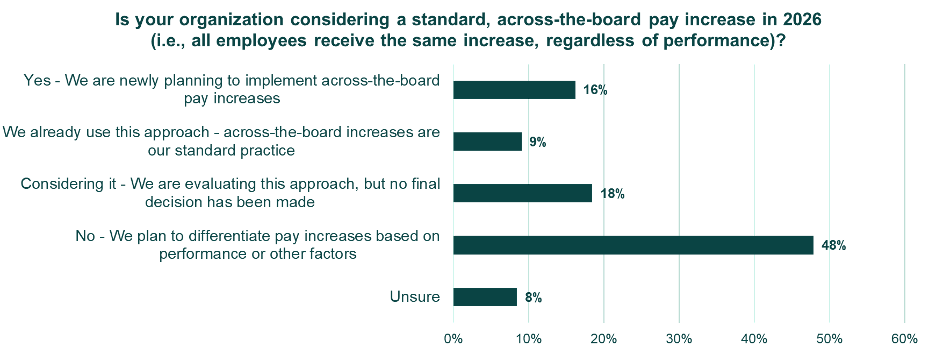
Payscale’s Pay Increase Preview Report shows more than two in five organizations are either implementing or considering across-the-board pay increases. Also called the “peanut butter” approach, this strategy abandons performance-based increases in favor of a uniform raise applied evenly across the organization.
These pay increases aren’t a new phenomenon; they often resurface during periods of economic uncertainty, last seen on the rise during the 2008 financial crisis.
The appeal for uniform pay increases is understandable. Performance-based increases have faced legitimate criticism for subjectivity and bias. When budgets are tight and HR teams are stretched thin, there’s simplicity in telling every employee they’ll receive the same 3.5% increase.
But that simplicity can come with a cost.
The Industries Moving—or Not Moving—to Uniform Pay Increases
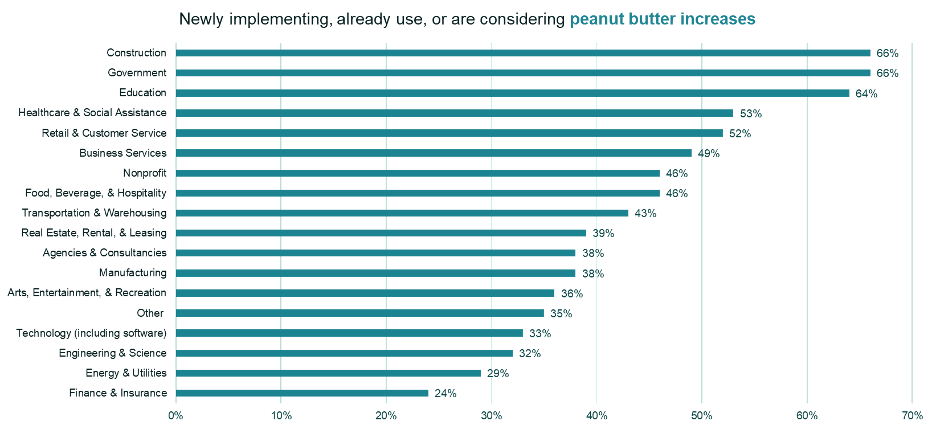
The data reveals patterns in the organizations embracing uniform pay raises and those holding the line on performance differentiation. Organizations with large frontline populations or lower-wage roles are more likely to rethink compensation differentiation as inflation continues to affect workers unevenly.
These industries are leading the charge on across-the-boarded salary increases:
- construction;
- education;
- government;
- healthcare and social assistance;
- nonprofit; and
- retail and customer service.
At the same time, 48% of organizations still plan to continue pay increases based on performance. These industries continue to emphasize pay-for-performance cultures:
- agencies and consultancies;
- energy and utilities;
- engineering and science;
- finance and insurance;
- manufacturing;
- real estate, rental, and leasing; and
- technology.
The Impact on Performance and Retention
Uniform pay raises spread increases evenly. But here’s the problem: It also spreads accountability thin. When compensation no longer reflects performance, a clear message is sent about what is valued — and what is not.
Periods like this demand heightened attention to retention. Regardless of labor market conditions, organizations can’t afford to lose their top talent. This becomes more difficult when short-term pay strategies turn into long-term retention problems.
For high performers, seeing the same salary increases awarded to average or lower performing peers weakens the connection between contribution and reward. Over time, engagement erodes. And so does tenure.
This is a retention risk waiting to happen. Without performance-driven pay strategies, organizations assume top talent will remain satisfied with being rewarded identically to colleagues. But history and human nature suggest otherwise.
Balancing Pay Equity and Performance
“Peanut butter” pay raises are not all bad. Organizations don’t have to choose between fairness and performance. The solution lies in thoughtful pay practice design, not abandoning pay-for-performance altogether.
Compensation strategies should align with organizational goals, labor market realities, and inflationary pressures, while also ensuring top performers feel valued and have a compelling reason to stay engaged.
Organizations using a uniform raise approach still have options to reward performance. Bonuses, promotions, long-term incentives, and movement within pay bands can recognize skill attainment, proficiency, or expanded responsibilities. In some cases, higher increases may be due to structure adjustments, meaning a change in the value of the job in the past year.
It’s also critical to look at the reasoning behind switching to a uniform pay increase, and ways to address each without revamping pay practices.
- Administrative burden: Streamline performance management processes rather than eliminating the compensation connection entirely.
- Bias: Improve rating systems through structured assessments, calibration sessions, and clearly defined performance criteria.
- Inflation: Target adjustments toward the most impacted workers while maintaining merit differentiation.
What Matters for 2026 Compensation Strategies
Economic uncertainty and budget constraints are real. So is the need for fairness and administrative simplicity. But as 2026 compensation strategies take shape, one scenario should be top of mind: When top performers receive the same increase as everyone else and are recruited away for a 15% bump, this approach may reveal itself as less efficient and more expensive than expected.
Top talent is always looking for their next opportunity, even if they’re not actively job hunting. The labor market remains tight. But that doesn’t mean pay-for-performance should disappear entirely. Top performers want to work for organizations that value their hard work and reward it financially.
The question isn’t whether organizations can afford to differentiate for performance. It’s whether they can afford not to. Fairness matters, but so does recognizing excellence. The most successful compensation strategies in 2026 will be the ones that successfully honor both.
Ruth Thomas is chief compensation strategist at Payscale.