


Four HR leaders offer insight into managing and empowering the workforce across different cultures, borders, and demographics.
By Simon Kent
The international world of business is complex, perhaps more challenging than ever before. As organisations spread their wings across borders and throughout the world, the need to manage diversity—not just by geography but according to culture, age, and other defining factors—has become an imperative for HR. If executives can set the stage carefully and take a more positive approach, they can reap the rewards of welcoming a workforce that is diverse in all directions.
In a panel at the HRO Today Forum EMEA, four HR leaders gave insight into the challenges and techniques they deploy to ensure they get the best from all their workforce, and that their workforce gets the best from their employer.
Between them, Kutay Kavukcu, head of HR for Asos; Omowunmi Adewusi, general counsel and HR director for AXA Mansard; Ainura Koshoeva, VP of OD and HR for Aquarius Software; and Clotilde Teson Ruiz, Europe and Asia director HR and culture, global director sustainability for Draxton, are responsible for thousands of employees across the EMEA region. And yet despite their different industry sectors, they clearly share a number of challenges and ideas.
First and foremost, it seems that cultural difference represents the primary challenge for HR, shortly followed by age diversity. In the case of the former, culture can dictate many aspects of a working relationship. It doesn’t just influence how work is viewed, but also the motivation and rewards required by the workforce.
One size certainly doesn’t fit all when dealing with staff across continents, even when determining how to initially engage or approach someone. Understanding culture can be crucial for making the right connection. Adewusi made clear that age diversity also has an impact on how HR needs to communicate across its workforce, generally and specifically—even determining how an individual might wish to be referred to by their employer.
Teson Ruiz also highlighted the irony of language across an international business such as hers. When employees from diverse countries met, in person or online, to discuss projects and so forth, the language they use is English, despite the fact that this is not the first language for any of them. In such a context, extra care must always be taken to ensure what is said is meant and also lands correctly for all.
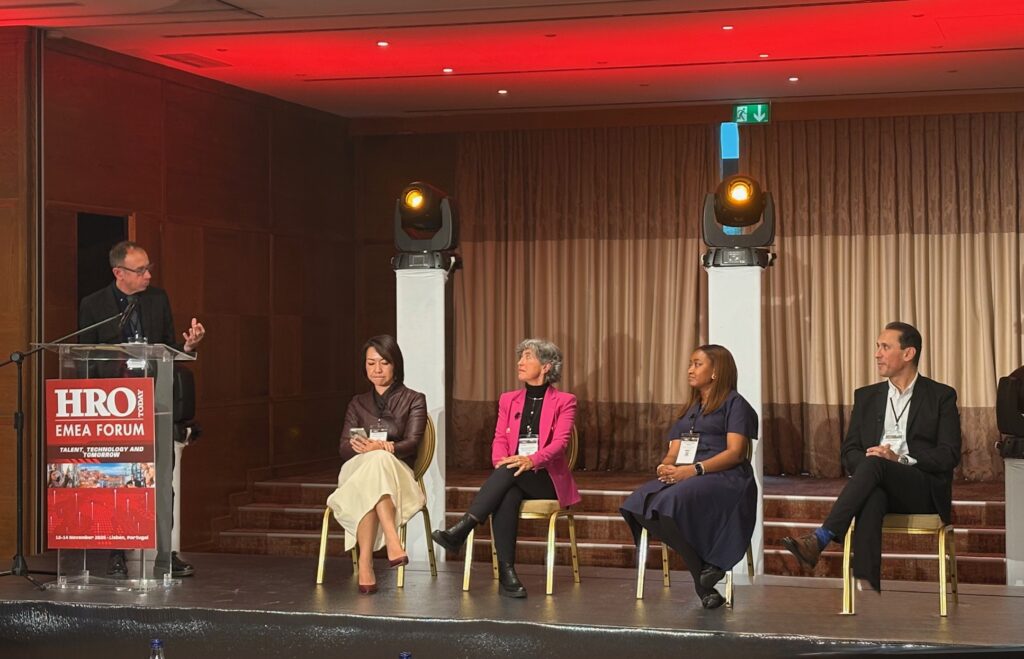
HRO Today EMEA Editor-at-Large Simon Kent leads a discussion with Ainura Koshoeva, VP of OD and HR for Aquarius Software; Clotilde Teson Ruiz, Europe and Asia director HR and culture, global director sustainability for Draxton; Omowunmi Adewusi, general counsel and HR director for AXA Mansard; and Kutay Kavukcu, head of HR for Asos.
Teson Ruiz described her teams as being intercultural rather than multicultural: the implication being that members of each team must work more closely with one another and with a greater understanding and appreciation of each person’s point of view. It is not enough to just know that people have different backgrounds and understandings; one needs to be proactive in managing the similarities and differences.
And this led to another thought which sparked further discussion: the idea of being intentional when addressing diversity within a business. When it comes to communication in particular, the panel agreed that it was important to be intentional in addressing people with diverse backgrounds and experiences. This means being proactive and finding a variety of ways in which they can communicate with employees, ensuring there is a method that lands effectively. The idea of being intentional is to ensure every individual is listened to and appreciated. There is not a sense that there is a “standard” way of doing things and some people fall outside that standard.
Being intentional extends to the creation of diverse teams and organisations. There have been countless studies showing how diversity can benefit organisations in a number of different ways and for industries and professions like engineering and science, organisations are keen to push back against the usual profile of candidates and to ensure diversity exists in background, gender, and generations. The panel gave examples of this within their own businesses, often working with colleagues to understand where bias might exist or why communications might not always be effective. There was a clear need for flexibility and adaptability from HR in the way it carries out its duties in order to keep everyone engaged and onboard.
Diversity also opens businesses up to new ideas and even markets. By getting the strategy right, organisations can capitalise on new ideas and approaches. The advent of the digital age has brought with it a wealth of digital products and services. Making the most of the opportunities that come with these can mean ensuring the ideas and opinions of younger, more digital savvy generations are listened to, enabling them to make contributions to their organisation.
All of the HR professionals on the panel agreed that organisations need to measure the impact of diversity initiatives on their business. It is not sufficient to just encourage diversity but to see how those people play out in each position. Companies can analyse the effectiveness of communications through their employee satisfaction survey as well as considering the impact diversity has on their operations more generally.
While it’s clear one-size-doesn’t-fit-all, these organisations do share an openness and willingness to welcome and work with diverse employees. They each have found challenges in doing so, but they have also gained strength from enabling diversity in their ranks. As the future promises further complexities within the workforce, businesses need to ready to operate on a worldwide basis benefitting from talent from anywhere and everywhere.