

|
Getting your Trinity Audio player ready...
|
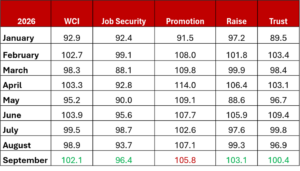
The Worker Confidence Index (WCI) report examines changing attitudes and perspectives of the American worker. However, HRO Today‘s traditional WCI report is based on quarterly findings, found here, through extensive online interviews of workers. Since the US economy and labor market have been markedly volatile and ever-changing, HRO Today is publishing shorter, monthly updates to the WCI to further examine the root cause behind quarterly changes and shifts in worker attitudes. This research is sponsored by LevelUP HCS.
September 2026:
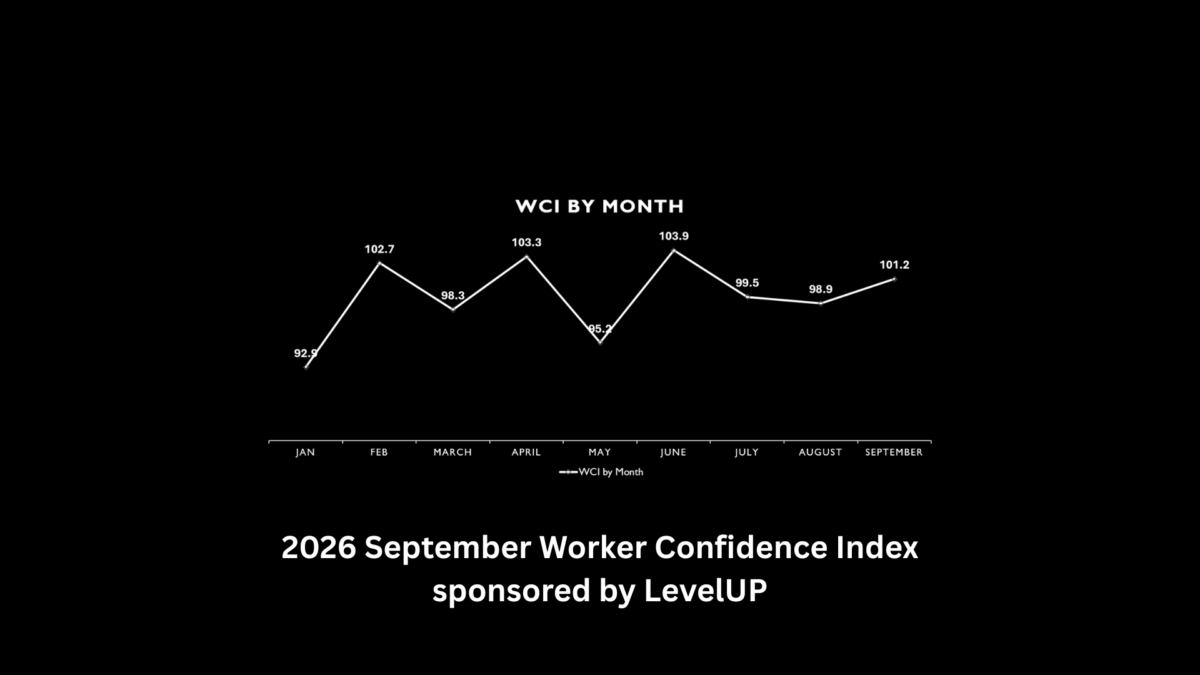
In September, the WCI increased by 2.3 points to 101.2. This marks the fourth time the overall WCI reached over 100, which only occurred three times in 2025. Most of its indices increased from August as expectations of a raise grew the most, by 3.8 points to 103.1. American workers are less likely to expect a promotion, the only index to decrease, though recently high levels indicate workers could have recently received a promotion, which naturally leads to lower levels. Overall, workers are feeling more confident within their current positions.
Though worker confidence increased overall, Americans are feeling significantly less confident in current and future business conditions and labor market growth. Both the Conference Board’s Present Situation Index and Expectations index, which measure consumer thoughts on current and future conditions, declined in September. The indices fell by 7.9 and 5.9 points, respectively. Though economic trends typically impact parts of the WCI, recent volatility has led to fluctuations within the indices.
Job security grew as the labor market continues to stagnate. In August, hires, quits, and layoffs were all fairly unchanged and levels have idled since June. The US labor market has grown minimally throughout the third quarter, only adding 29,000 jobs in September. Unemployment increased slightly to 4.2%. As turnover can be costly and negatively affect operations, and layoff levels stay unchanged, workers are confident in keeping their current jobs. As organizations and workers continue exercising caution, these trends will be paramount to understanding future labor market needs.
August 2026:
In August, the WCI decreased slightly, by 0.6 points to 98.9. This is the slightest monthly decline in 2026, where the next smallest decline was 4.4 points, and the second consecutive monthly decline. Similarly, the Conference Board’s Consumer Confidence Index® fell by 0.8 points. This downward plateau reflects stagnating conditions as the summer season ends. The Job Security and Trust in Company Leadership indices both decreased, by 5 and 2.9 points, respectively. As companies continue ramping up retention efforts, employees are more likely to expect a promotion and a raise in the upcoming months, by 4.5 and 1.7 points, respectively.
The Likelihood of a Raise index, which increased by 2.9 points, has been especially volatile as employee wages have grown at the slowest pace recorded since May 2021. Prices are rising by 3.5% year-over-year compared to wage growth of 3.2%. As inflation levels are still high, workers are feeling optimistic about wage growth amid high corporate profits.
Job security fell by 5 points, the second largest monthly decline in 2026. As seasonal positions wrap up, the number of temporary layoffs increased by over 150,000 in July, affecting job security levels. Additionally, the labor market lost 23,000 jobs, which could be later revised to reflect a larger loss. The rise in AI investment slowed hiring in some industries as companies are hesitant to expand their workforce while developing AI-based products. New job creation and retention efforts will be paramount to the WCI and its indices.
July 2026:
After a strong showing in June, the Worker Confidence Index and most of its indices declined in July. The WCI dipped below 100 for the fourth time this year after July’s 4.4-point decline. Job Security was the only index to increase. Similarly, the Conference Board’s Consumer Confidence Index® fell by 1.4 points.
The Job Security index grew by 3.2 points in July. Interestingly, the U.S. labor market was exceptionally cool in June and July. Only 57,000 jobs were added in June after May’s levels were downwardly revised. In July, the labor market lost over 23,000 jobs. The unemployment rate continues hovering around 4.2%. In addition to minimal labor market growth, the number of employed people has been declining slightly each month since April. Regardless of these seemingly bleak indicators, American workers feel more confident in their current jobs.
Likelihood of a Promotion, the only index to decline for two consecutive months, fell by 5.2 points, its lowest point since January. Employees may feel less likely to receive a promotion for a myriad of reasons, including recent upwards mobility, hiring freezes, and mid-career stalls. As the labor market sees minimal growth, more employees could face mid-career stalls, losing career momentum amid prolonged workforce stagnation.
Interestingly, trust in company leadership declined the most, by 9.7 points. Employees with high levels of company leadership trust typically hold higher levels of productivity and engagement, which is paramount to company success. Lower levels of visibility or workplace communication can harm trust in company leadership, sometimes long-term. Previously, lower levels of trust in company leadership took months to recover. In 2026, trust has been especially volatile, fluctuating month by month and rebounding easily. External factors, like economic turmoil and high levels of geopolitical tension, can also impact levels of company leadership trust.
June 2026:
Following May’s stark decline, the WCI, and most of its indices, rebounded and hit its highest monthly level in 2026. Likelihood of a Promotion was the only index to decline, likely as employers center promotions and internal growth within retention efforts. Naturally, workers are less likely to expect a promotion after recently receiving one.
The Job Security index reached its highest monthly level in 2026 as 172,000 jobs were added in May. Though workers feel more secure in their jobs, underutilization continues to plague the workforce. On average, workers now are employed fewer hours, experience longer periods of unemployment, and face lower wages. As the workforce becomes more difficult to enter, workers in full-time roles are driving job security upwards. Reflecting a similar sentiment, the Conference Board’s Consumer Confidence Index® rose by 0.6 points to 91.2.
Confidence in a raise continues to fluctuate. Workers are feeling more confident about business conditions, which could fuel anticipation in an increase in pay. However, as inflation hits its highest level since 2023, companies and their workers could have mismatched expectations. As prices continue to rise, pay raises could become less common but more sought after.
Levels of employee trust in their company leadership hit a new monthly high for 2026. This signifies that organizations are communicating clearly and acting transparently, though levels of trust have fluctuated throughout the year. Month-to-month, the number of layoffs has been unchanged since April, which could contribute to higher levels of trust as workers adjust to a new norm. Layoffs can quickly destroy employee trust in companies, though leaders can act to preserve these levels.
As June officially kicks off the summer season, worker attitudes will continue to vary.
May 2026:
The monthly WCI and its indices all declined after April’s sudden jump. Job Security felt the smallest decline, by 2.8 points, likely caused by a stagnate labor market experiencing mild growth amid consistent layoffs. Unemployment has been steady around 4.3% while the labor market boasted 7.6 million open jobs in April, the most since May 2024. The Likelihood of a Raise index felt the starkest drop, by 17.8 points, as raises are less typical mid-year and the economy constricts. Overall, workers are feeling less confident, though the level of decline is mainly attributed to falling expectations in a raise.
Confidence among American workers is dropping amid prolonged conflict in the Middle East, rising prices and inflation, and an unmoving labor market. The Conference Board’s Consumer Confidence Index® dropped by 0.7 points to 93.1. The Present Situation Index, measuring current business and labor market performance, decreased by 3.2 points, though the Expectations Index, measuring short-term business and labor market outlooks, rose by 74.4 points. Though American workers are less confident now, they are optimistic for the future.
After high levels of confidence in receiving both a raise and a promotion in April, both indices declined. However, this behavior can be typical mid-year, and the likelihood of a promotion is still up dramatically year-over-year, likely as retention strategies continue. Notably, employee trust in company leadership declined to its lowest level of 2026. Rising levels of distrust during times of geopolitical and economic tension can affect overall productivity, retention, and engagement. Once trust in company leadership is lost, earning it back can be particularly difficult, especially if retention strategies remain limited to offset organizational costs. Employee behavior and trends during the next few months will be pivotal.
April 2026:
After sharp declines in March, the monthly WCI recovered and hit a new high for 2026. According to the Conference Board, consumer confidence was up by 0.6 points in April, though consumer assessment of the current state of the labor market and business conditions declined. Overall, workers are feeling more confident after the stark drop felt in February.
Again, job security is low. The number of monthly layoffs has been fairly unchanged throughout the first few months of 2026, hovering around 1.9 million. Additionally, job growth was minimal as the labor market continues its stagnation. Jobs and hiring within the federal government and the professional/business services sectors fell. As oil prices surge and the conflict in Iran continues, American workers’ feelings of job security will fluctuate, especially as particular industries are impacted by economic constraints.
Workers are feeling more confident in receiving both a promotion and a raise, likely as part of ongoing retention strategies. Plus, workers might expect higher levels of recognition mid-year as the end of Q2 looms. Trust in company leadership rebounded to 103.1. Organizational transparency and authenticity, especially during times of global conflict and instability, are imperative to keeping employee trust. As geopolitical turmoil continues, trust in company leadership will either strengthen or fall dramatically.
March 2026:
Overall confidence declined, by 4.4 points to 98.3, following February’s peak. Three of the four indices declined. Job Security dropped the most, by 11 points to 88.1. Likelihood of a Promotion saw the sole increase.
In March, 178,000 jobs were added as the health care and construction sectors continue to grow, surpassing initial growth expectations. Considering the downward revisions to jobs added in February, this marks the largest monthly job growth since December 2024. However, as downward revisions become the norm, job growth does not always directly impact overall feelings of job security, especially when job growth is centralized to specific sectors.
Workers, along with the economy, are feeling the impact of the conflict in Iran. Energy costs, inflation, and consumer prices continue to soar, negatively impacting overall worker confidence. Consumer sentiment hit a historic low, a possible signal to prolonged economic stagnation as workers prepare for more economic instability. The overall extent of this impact has yet to be determined.
February 2026:
In February, confidence increased significantly, by 9.8 points to 102.7. This dramatic increase indicates renewed optimism among workers, likely driven by improving short-term expectations. American workers felt a stark jump in the likelihood of receiving a promotion and in company leadership trust.
Over 130,000 jobs were added in January, fueling worker confidence. Interestingly, most of this growth affects blue-collar jobs, which historically hold a lower level of overall confidence.
This renewed sense of optimism is unlikely to last following US attacks on Iran. Times of conflict can easily exacerbate employee fear of job loss or lead to wavering levels of company trust, depending on organizational responses and economic impact. Additionally, worker anticipation in job advancement may vary, along with trust in company leadership as organizations navigate an unpredictable landscape.
January 2026:
Overall worker confidence declined to 92.9 to start 2026. Post-holiday and end-of-year slowdowns can occur without longstanding implications, especially as workers may receive promotions or raises, affecting optimism to start the year. Additionally, seasonal positions usually end throughout the first months of the year.
Consumer confidence dropped in January to 84.6, its lowest level in over a year. This dampening sentiment may cause workers to reassess their overall expectations.
Unemployment is relatively stable at 4.3% as the health care and construction sectors led job growth. The number of job openings, hires, and separations were all relatively unchanged as the labor market stagnates to start the year.
This research is produced in conjunction with LevelUP Human Capital Solutions (LevelUP HCS). LevelUP partners with HR and Talent Acquisition leaders to deliver faster, smarter hiring outcomes.