

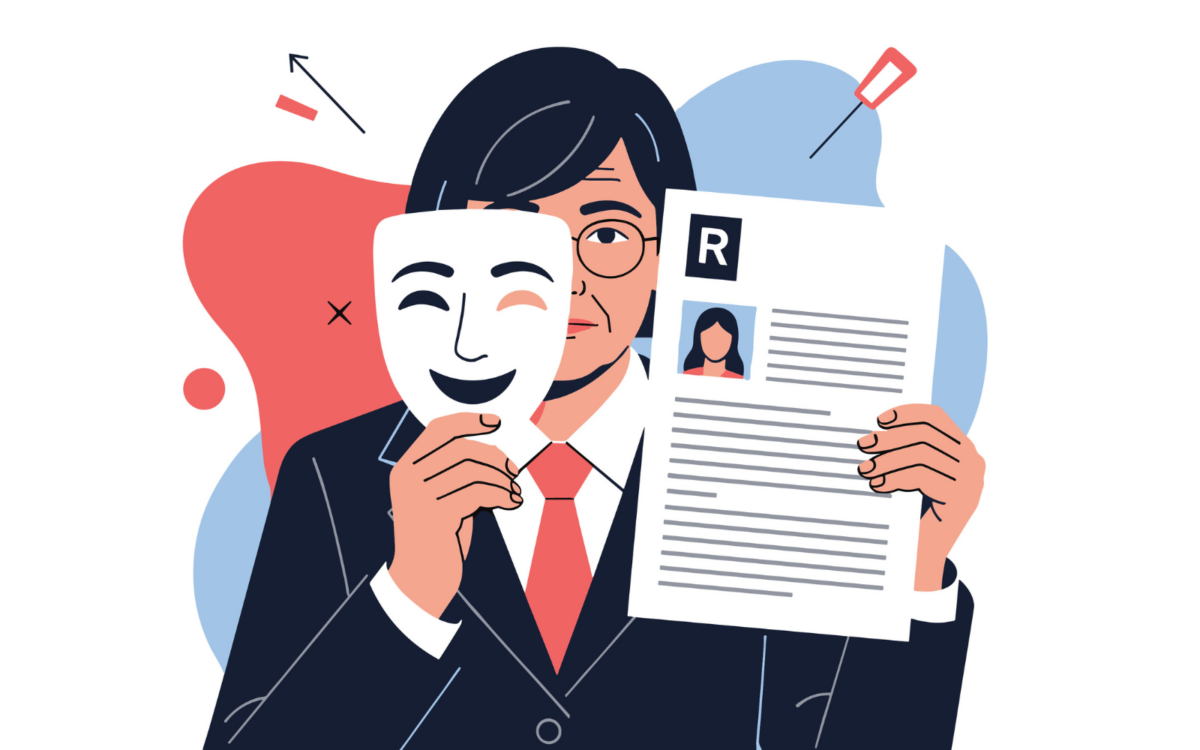


Navigating New Frontiers: Candidate Fraud in Modern Hiring
“Companies today must not only detect fraud, but continuously adjust their recruiting process to stay ahead of new tactics.”
Got five minutes? That’s all it takes to get a breakthrough. In this quick-hit interview with Rebecca Käppeler of KellyOCG breaks down how to wade through the murky waters of this new era of candidate fraud.
HRO Today Association: Employers have always faced some degree of candidate misrepresentation, but advances in technology have transformed both the scale and sophistication of the challenge. What are the biggest shifts you’re seeing today?
Rebecca Käppeler: AI dramatically enhances the speed and scale at which candidates can now alter or enhance credentials and responses. The challenge is that there are simply more ways than ever to trick the system.
Candidates may use AI tools to more convincingly embellish their résumés and cover letters. They can have someone else take their technical assessment for them or even use deepfake video interviews, making it harder to detect inconsistencies. Online diploma mills and false identities add to the risk.
Just a few years ago, candidate fraud was far less sophisticated. Some candidates may have lied about their experience or overstated their skills, but the risks did not change dramatically over time. Today, the companies we work with, whether in an RPO, MSP, or total talent context, are in a position where they must not only detect fraud, but continuously adjust their recruiting process to stay ahead of new tactics.
HROTA: Remote and global hiring have expanded access to talent, but they’ve also introduced new challenges. How has the evolution of virtual recruiting changed the way organisations need to think about candidate authenticity and verification?
Rebecca Käppeler: Remote hiring and virtual recruiting create entirely new challenges over physical, on-site interactions, so traditional verification processes are not enough.
Organisations can’t always rely on in-person identification or local background checks. Identity proofing, interview assessment, and onboarding are often disconnected, which makes it easier for fraud to slip through.
Global and remote hiring opens vast talent pools, but requires more rigorous digital identity checks, cross-border background verification, and continuous monitoring. Video interviews and asynchronous assessments are now common, but so are impersonations and deepfakes.
Companies are beginning to overhaul their processes — for example by introducing biometric verification, AI-driven proctoring, and global background databases to keep up. Interview design is evolving to help spot proxies and deepfakes.
Tactics such as camera moves, screensharing, or even physical gestures such as the “hand wave test” are examples. But you can’t lean on any measure permanently. Over time, people will find a way around your verification process, so you must keep your eyes open and evolve to stay ahead.
HROTA: What’s the biggest misconception organisations have about candidate fraud, and where are employers most vulnerable without realising it?
Rebecca Käppeler: A common misconception is that candidate fraud is rare. But Gartner and other analysts predict that as many as one in four candidate profiles may be at least partially fake by 2028. Today, 38.5% of AI-powered interviews show signs of cheating, and up to 48% for technical roles. This makes the risk of candidate fraud firmly rooted and growing.
Another misconception is that candidate fraud only affects certain roles, but any level of business can be targeted. Companies need to think about all of their hiring access points, including permanent or fixed-term hires, freelancers, acquired staff, temporary employees, and vendors.
Any data can be targeted, whether IP and financial data, job data, or customer information. Reliance on a single detection raises an employer’s vulnerability. Résumé screening, single-pass reference checks, or take-home assessments can all make an employer vulnerable if they’re not part of a larger anti-fraud strategy.
HROTA: Organisations are under pressure to fill critical roles quickly while maintaining a positive candidate experience. What are the most effective strategies for strengthening hiring integrity without creating unnecessary friction for candidates?
Rebecca Käppeler: Expanding your anti-fraud tactics weighs on the candidate experience if not handled well. But getting it right doesn’t have to be impossible; you just need to be intentional in your approach:
- First and foremost, be transparent about what you’re doing to verify them. Trust is everything, and it is a two-way street.
- Use passive verification, such as secure document uploads or biometric ID checks.
- Implement multifactor authentication for assessments.
- Apply AI monitoring for suspicious activities during online evaluations, but do so transparently.
- Utilise API-connected, automated background checks.
If you minimise interruption for genuine candidates while creating hurdles for fraudsters, you’re a step ahead.
HROTA: As AI continues to reshape the hiring process, what will separate organisations that successfully stay ahead of candidate fraud from those that are constantly reacting to it?
Rebecca Käppeler: Organisations that stay ahead of evolving candidate fraud do so by taking a holistic, continually evolving approach to security. To stay in front, several fundamentals come into play:
- Assemble a cross-functional team to look at your strategy to combat candidate fraud. That group should include internal teams such as legal, security, cyber, and risk, in addition to HR and TA.
- Put that team into action. They should be mapping access points and assessing which data could be targeted for fraud. They should also be evaluating your tech stack on a regular basis. Likewise, don’t overlook the need for compliance in areas such as AI, biometrics, privacy, and fair reporting. Those regulations change, so you must stay up to date.
- Invest in AI forensics and integrate anti-fraud detection into the hiring workflow. Collaborate with third-party experts for threat intelligence and update your verification processes as technology evolves.
- Don’t stop at processes and technologies. Culture and training are just as important. Focus on culture and training topics: building a culture of integrity, providing avenues for appeal, maintaining human oversight on final decisions, and supporting both compliance and trust.
- Establish that recruiters and hiring managers understand their part. They need to be transparent with the candidate about verification. They need to know the fraud signals and what to do when they spot them. Where there are gaps, training comes into play. In any case, training and internal stakeholder education should be part of a continuous programme.
Those organisations that just implement one-off checks or react after incidents will struggle to keep up. The winners will treat hiring security as a dynamic, strategic function.
Want more quick-hit insights from HR leaders? Explore the full HR Breakthroughs series for more conversations designed to spark innovation, tackle challenges, and uncover opportunities for growth.
Have expertise to share? We’d love to have you. Email Connor.Feeney@SharedXpertise.com to sit down for your own HR Breakthroughs interview — video or written, you pick the topic, we handle the rest.